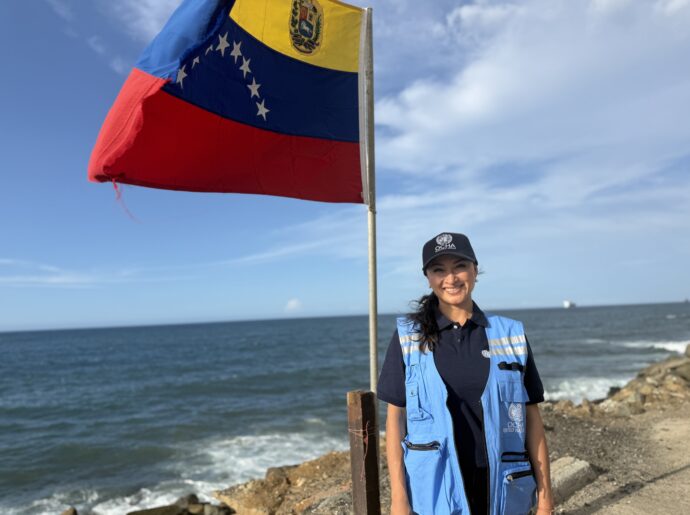
Ready for deployment: Private sector participation in the UNDAC induction
As a disaster management professional, I have always set my sights on a few ambitious “moonshot” goals. One of the most significant has been integrating private sector representatives into rapid response teams—a space typically dominated by United Nations (UN) and government personnel. While there are several examples of companies organizing their own rapid response teams and who work with government and humanitarian partners, there are still limited models on how existing global and regional response mechanisms have included private sector technical experts into their own response teams.
In May 2024, I travelled to South Korea to attend the induction course for the United Nations Disaster Assessment and Coordination (UNDAC) system. Managed by the United Nations Office for the Coordination of Humanitarian Affairs (OCHA), this intensive course is designed to equip OCHA staff and operational partners with the tools needed to manage humanitarian coordination particularly during sudden-onset emergencies.
I had the privilege of representing the OCHA/UNDP Connecting Business initiative, while my colleague participated on behalf of OCHA’s Private Sector Unit. I was also happy to see a representative from DHL, one of OCHA’s longest standing private sector partner—19 years and counting—joining the course as one of the facilitators.
The UNDAC induction course experience
Many of my co-participants came from OCHA, other UN agencies and national disaster management agencies. While experienced humanitarian professionals, they also had limited exposure to concrete examples of effective private sector collaboration in disaster response. In fact, some were understandably wary, given that based on field experiences, humanitarian responders often receive donations of goods that are not useful. They have also experienced duplication of efforts as seen when businesses get involved. This skepticism is exactly why the Connecting Business initiative (CBI) exists—to streamline and coordinate private sector initiatives in preparedness, response and recovery, and to avoid these inefficiencies.
Despite the initial reservations, any disaster management professional knows that local businesses can be invaluable in the immediate aftermath of an emergency. During the first crucial weeks, sharing information and pooling resources with the private sector can significantly enhance response efforts.
The two-week induction UNDAC induction course was a mix of lectures, discussions, tabletop exercises, and a two-day simulation exercise. Our simulation exercise involved a Category 5 Tropical Cyclone hitting a fictional country called Epigonia—a scenario designed to exercise our response coordination skills in a high-stake, complex emergency. The UNDAC training team tailors these simulations based on regional risk profiles.
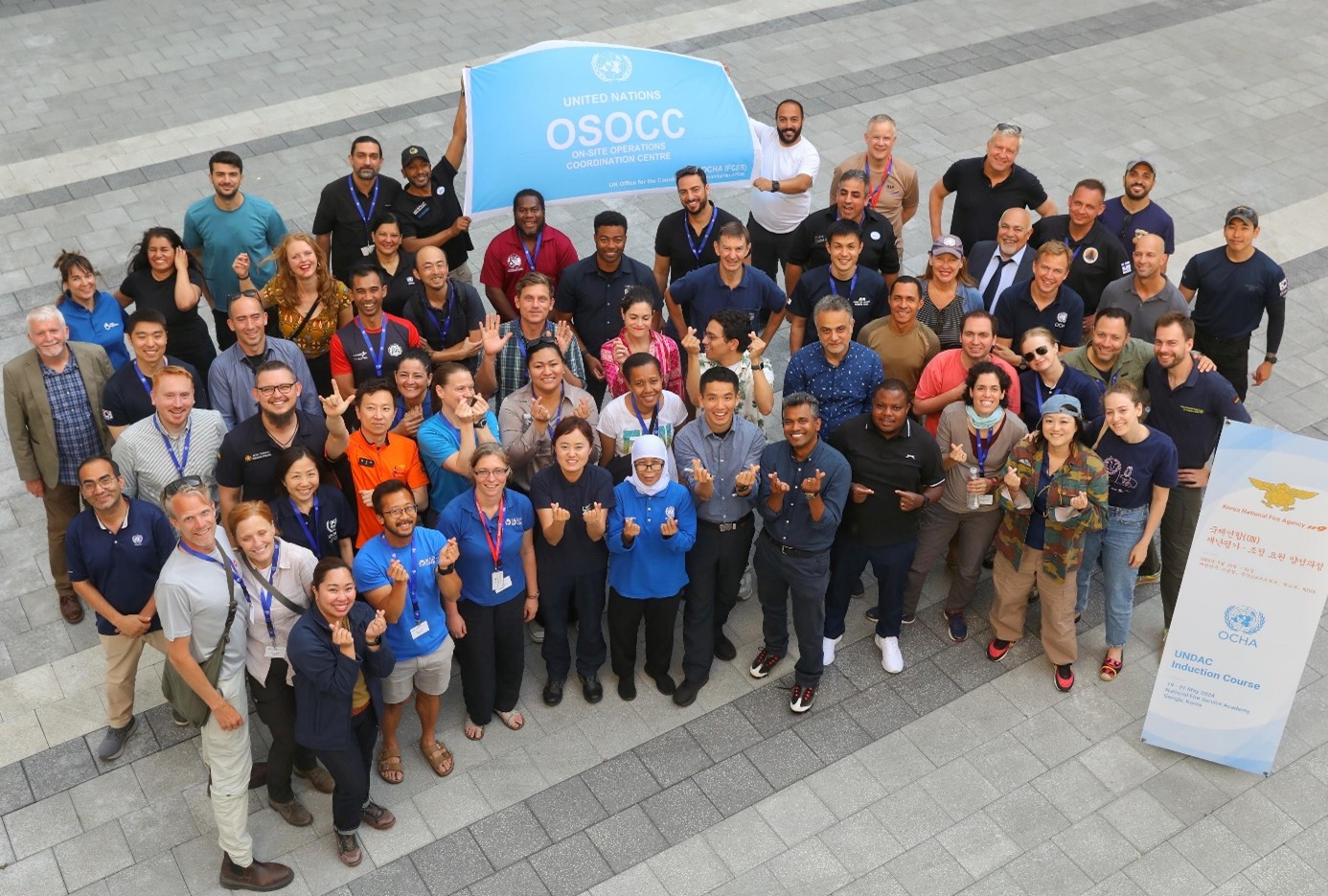
We were a group of just over 30 participants from around the world and I had the opportunity to facilitate a session on private sector engagement during emergencies based on the recent updates on this section in the newest edition of the UNDAC field guidebook. The updated section on private sector engagement offers practical examples and guidelines for cross-sector collaboration.
The diversity of the facilitators—from organizations like the International Federation of the Red Cross, OCHA regional and country offices, international humanitarian partners like MapAction and Atlas Logistique—made the exchanges and exercises even more enriching. This diverse expertise reflected the real-world dynamics of an UNDAC deployment, where coordination across various actors is key to a successful mission.
Part of the cohort in front of one of the orange operations tents. Photo: OCHA
The tents served as our center of operations for the simulation exercises. Photo: OCHA
A taste of Korea
I would be remiss not to mention the exceptional hospitality of our hosts, the Korean National Fire Service Academy. The hosts provided a training venue with all the facilities (and food!) needed for a successful UNDAC induction course. They even arranged a cultural reception and a weekend trip to Seoul, offering us a taste of Korean culture.
These experiences were not just enjoyable—they played a significant role in fostering camaraderie within our batch. By building stronger personal connections, we reinforced our collective commitment to collaborate effectively if and when we are deployed to respond to future emergencies.
Key take-aways and looking to the future
Reflecting on this experience, I am grateful for the opportunity to achieve both a professional and personal milestone—one that, I hope, will lead to more effective public-private collaboration in disaster response.
What stood out the most was the realization that preparing for deployment goes beyond seniority or technical expertise. It’s about adaptability, teamwork and a readiness to take action when needed. I feel confident that these new skills and perspectives have equipped me to contribute effectively in an UNDAC mission, whenever it may be.
Throughout the training, we learnt a lot and connected as individuals. Here. Florian Rhiza Nery from CBI (left), Jeonghee Jin from the National Fire Agency Korea (middle), and Titi Moektijasih from OCHA Indonesia (right). Photo: Florian Rhiza Nery/CBI