From advocacy to co-creation: This year’s humanitarian conference HNPW 2025
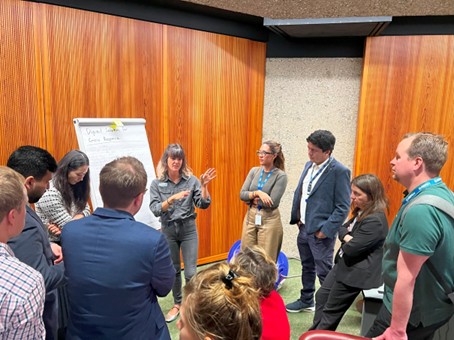
“Humanitarian response cannot be effective in silos. The private sector is already providing innovative solutions; but to maximise impact, these efforts need to be better integrated and aligned with humanitarian coordination structures.
What we need to do here together, is co-create, reimagining what the humanitarian – and development sector could be, how we can do things. And we cannot do that alone.”
– Veronica Gabaldon, Executive Director of the Philippine Disaster Resilience Foundation
This year’s Humanitarian Networks and Partnerships Weeks was almost cancelled given the challenges facing the humanitarian sector, but the United Nations Office for the Coordination of Humanitarian Affairs (OCHA) and its partners felt that the humanitarian sector needed to come together more than ever to connect and collectively reimagine what the sector might look like in the not so distant future.
As every year, the OCHA-UNDP Connecting Business initiative organized a number of sessions relating to business engagement in disaster management:
- A private sector networking session on the first day of the in-person conference,
- A session on “Harnessing the Power of the Private Sector for More Effective Humanitarian Action”, and
- A session on “Leveraging Digital Innovation for Disaster Preparedness, Anticipatory Action, and Emergency Response”.
“The ambition is a humanitarian sector that is ‘as anticipatory as possible and only as reactive as necessary‘ “- Leonardo Milano, Centre for Humanitarian Data, OCHA
Starting with the basics: Connecting over key topics
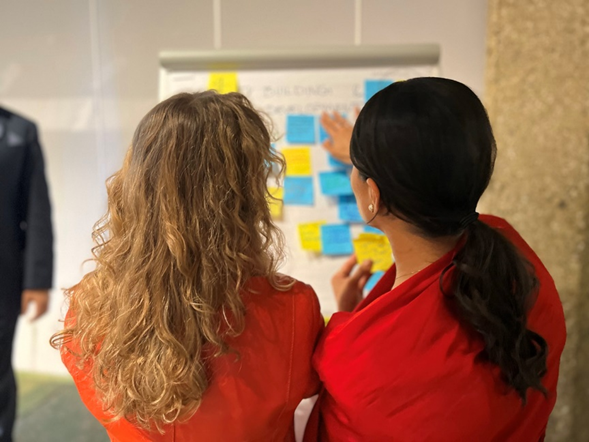
Participants were invited to rotate between stations so as to co-create solutions on four key topics pertaining to disaster management:
- Logistics and Supply Chain Innovation,
- Digital Solutions for Crisis Response,
- Financing Mechanisms for Humanitarian Action, and
- Capacity Building and Skills Development.
The networking exercise sparked valuable insights into key challenges and opportunities across sectors, fostering open dialogue among private sector, government, humanitarian, and development actors.
Conversations that reflected the breadth of the potential of public-private partnerships for emergency response
Throughout the week, conversations drove home some of the key topics that partnerships with the private sector could tackle, such as supply chain resilience, climate predictability, better understanding and addressing community needs. The red thread was how to catalyse efficiency and scalability, avoiding duplication and keeping costs as low as possible while still delivering life-saving solutions and paving the way for longer-term recovery.
“At Amazon Web Services, we support the use of data and technology in disaster preparedness and anticipatory action by optimizing supply chains and enhancing climate predictability through digital innovation, and are keenly aware of the extensive opportunities for pro-bono work to drive change.” – Sarah Hegeveld, Amazon Web Services
Going a little deeper identified a number of essential elements to any successful partnership, such as long-term commitment, targeted areas of action, flexibility and continuous dialogue, as well as leveraging local responses to increase crisis response and recovery efforts, for more lives and livelihoods saved.
The longest-standing partnership OCHA has is with the DHL Group. The collaboration focuses on logistics support in the case of emergency response, and has been going strong for 20 years in 2025.
Given the funding context, innovative financing such as social bonds as a type of impact investment was proposed as part of the tools that could be used to rethink the humanitarian sector. However, hand-in-hand with questions of financing come the need to record spending for greater transparency, accountability, and impact reporting.

Digital tools and technology at the service of disaster management
We live in a time of information overload as well as misinformation. How can technology and innovative digital tools enable solutions that respect data privacy, using data responsibly and ethically leveraging analytics for effective disaster preparedness, response, and recovery?
Data in a time of crisis needs to be accessible and quality-controlled, with tools taking big data sets and turning them into coherent information that can feed into informed decision-making. Artificial intelligence has an enormous potential, but is also only as good as the data that is fed into it and the algorithms it builds on, so it can easily amplify biases and vulnerabilities.
“Every disaster is a data disaster – but it doesn’t have to be,” said Florian Rhiza Nery, Deputy Programme Coordinator, CBi. “Innovation means local solutions powered by technology — designed for dignity, driven by impact, and built to scale.“
“Every disaster is a data disaster – but it doesn’t have to be. Innovation means local solutions powered by technology — designed for dignity, driven by impact, and built to scale.” —Florian Rhiza Nery, Deputy Programme Coordinator, CBI
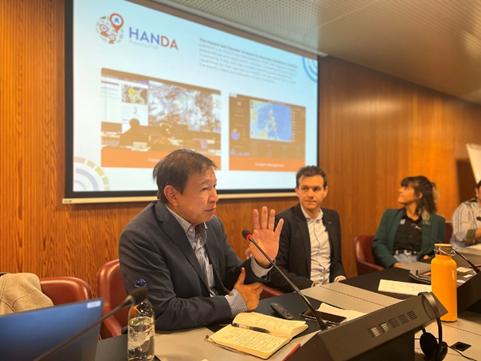
Two of the overarching takeaways were first, the call for bravery in trying new approaches and fostering cultural alignment to overcome persistent barriers and achieve integrated, strategic cooperation for greater public-private partnerships in disaster management; and second, that the future of disaster preparedness and response lies in efficiency, scalability, and collaboration.