FBCCI and OCHA Strengthen Coordinated Private Sector Engagement for Humanitarian Action in Bangladesh
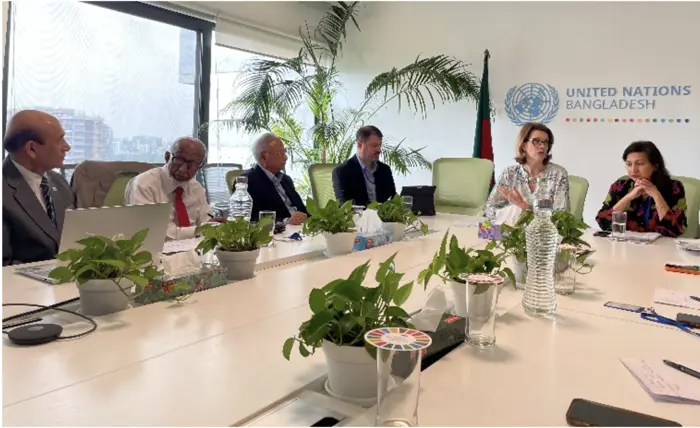
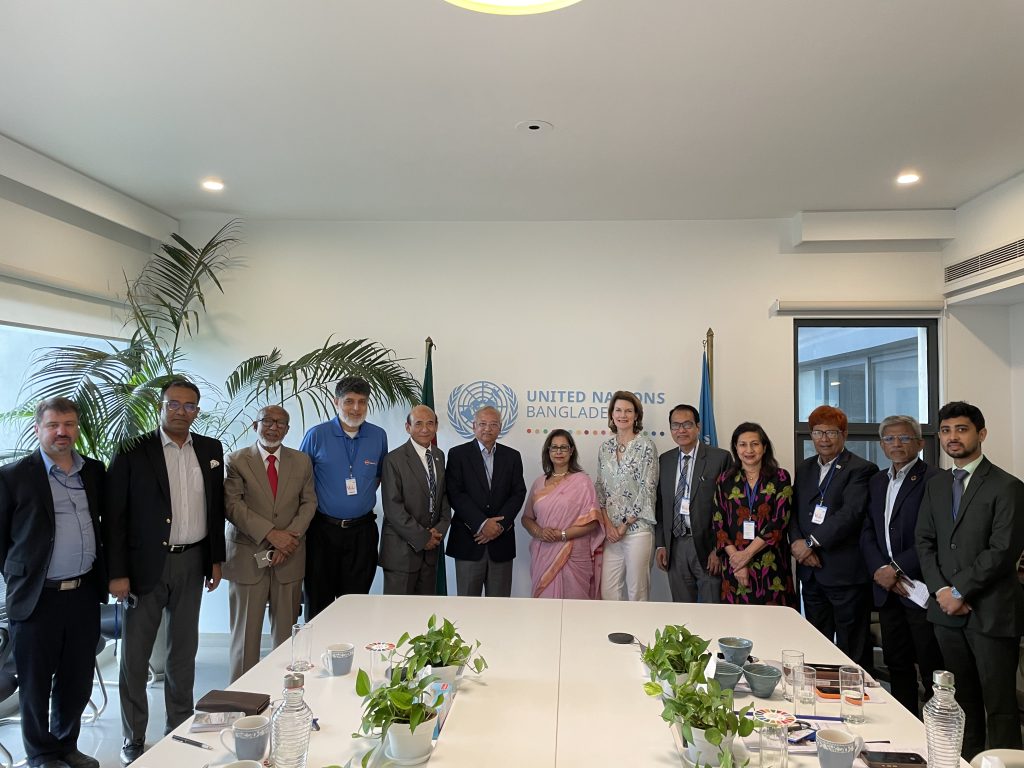
The Federation of Bangladesh Chambers of Commerce and Industry (FBCCI) and the United Nations Office for the Coordination of Humanitarian Affairs (OCHA) met at the UN House in Dhaka to advance more structured, predictable, and coordinated private sector engagement in Bangladesh’s humanitarian preparedness and response architecture.
Lisa Doughten, Director of OCHA’s Financing and Outreach Division, highlighted Bangladesh’s continued importance among OCHA’s priority contexts in Asia. Discussions focused on how business networks can connect their capabilities – logistics, services, supply chains, and local reach – into established humanitarian coordination systems so that private sector contributions complement response leadership, reduce duplication, and reach people faster.
A key point in the dialogue was FBCCI’s recent admission as the 22nd member network of the Connecting Business initiative (CBI). For Bangladesh, this membership provides a pathway to further institutionalize engagement with the private sector across the full disaster management cycle—preparedness, response, and recovery—while aligning business action with humanitarian coordination standards and nationally led priorities. Speaking at the meeting, Md. Alamgir, Secretary General of FBCCI said “As the 22nd proud member of the Connecting Business Initiative, FBCCI serves as Bangladesh’s private sector coordination platform for disaster risk reduction – linking nationwide business networks, mobilising resources, and strengthening localised, inclusive, and resilient humanitarian response in partnership with United Nations Office for the Coordination of Humanitarian Affairs.”
Participants also explored how private sector engagement can be better aligned with established humanitarian frameworks and financing instruments, including the Central Emergency Response Fund (CERF), Country-Based Pooled Funds, and the Humanitarian Response Plan (HRP). Grounding engagement in these mechanisms helps ensure support is needs-based, coordinated, and connected to the wider humanitarian system rather than operating in parallel. To translate shared intent into practice, FBCCI and OCHA identified several potential areas of structured cooperation, including:
- Joint training and familiarization on humanitarian coordination mechanisms such as the Cluster System and Humanitarian Country Team (HCT) processes.
- Pilot initiatives for private sector-led emergency coordination, including rapid response, resource mobilization, and business continuity considerations.
- Strengthened linkages between the FBCCI Safety Council and national/global coordination platforms to support early coordination and joint planning during crises.
These steps reflect a core CBI approach: enabling business networks to serve as a trusted interface between companies and humanitarian counterparts so private sector capabilities can be mobilized quickly and responsibly when emergencies occur.
The meeting also highlighted the role the private sector can play in gender-sensitive and inclusive humanitarian action, including support for women-led enterprise recovery, strengthening micro-, small, and medium enterprises (MSMEs), and improving equitable access to relief and recovery support
Both parties agreed to explore establishing a sector-specific private sector humanitarian coordination platform under the FBCCI Safety Council, aimed at improving early coordination and preparedness planning with humanitarian partners. The meeting concluded with a shared commitment to develop a scalable private sector–humanitarian partnership model in Bangladesh that could also offer lessons for other contexts.
Participants included representatives from FBCCI member entities and leadership, including MCCI President Kamran T. Rahman, PRAN-RFL Group Chairman Ahsan Khan Chowdhury, FBCCI Secretary General Md Alamgir, and FBCCI Safety Council Adviser Brigadier General (retd) Abu Naeem Md Shahidullah, among other senior FBCCI officials.