From Policy to Practice: Turkish Business Leaders Champion Gender-Responsive Supply Chains
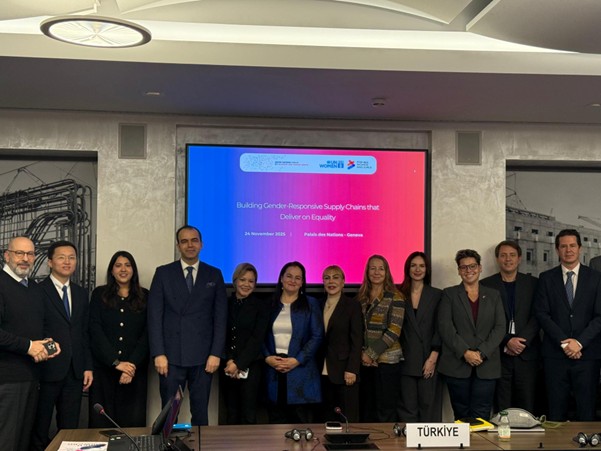
At the 14th United Nations Forum on Business and Human Rights taking place this week in Geneva, Switzerland, Turkish business confederation TÜRKONFED demonstrated how gender equality commitments can translate into tangible economic opportunities for women entrepreneurs across supply chains.
The Connecting Business initiative (CBI) Member Network participated in a high-level side event organized by UN Women and the Office of the High Commissioner for Human Rights (OHCHR), on “Building Gender-Responsive Supply Chains that Deliver on Equality.” The session brought together business associations, international organizations, and companies to discuss practical pathways for embedding women’s economic empowerment into procurement and business operations.
TÜRKONFED Moderating a the Conversation on Gender-Responsive Procurement
TÜRKONFED Secretary General Arda Batu moderated the panel discussion, guiding an exchange between representatives from the International Trade Centre’s SheTrades initiative, the International Labour Organization, UN Global Compact, and Kazakhstan’s DAMU Entrepreneurship Development Fund. The conversation highlighted both the persistent barriers women-owned businesses face and the innovative solutions emerging across different regions.
Turkish Models for Gender-Responsive Procurement
Two Turkish initiatives showcased during the panel demonstrated what gender-responsive procurement looks like in practice.
Prof. Dr. Yasemin Açık, Chairman of the Board of Trustees of the Açık Foundation, presented a comprehensive approach to supporting women entrepreneurs across Türkiye’s agricultural sector. She shared how the foundation has supported over 81,000 women entrepreneurs across more than 25 villages throughout Türkiye. The foundation addresses critical gaps women-owned businesses face: enhanced access to finance, improved information networks to simplify regulatory requirements, technical and STEM skills development, and structured mentoring opportunities. Through its “Women in Business” component, the foundation creates space for women-owned businesses to connect with potential buyers and demonstrate their capabilities in-house, making visible what is often an invisible supply chain challenge.
Yıldız Holding, one of the world’s largest food and beverage companies with operations spanning across the world, outlined its systematic approach to implementing women’s economic empowerment principles across its global supply chain. Begüm Mutuş, Global General Manager of Public Affairs, explained how the company it has increased representation of women-led businesses within its supply chain network from 1 to 37 percent in only 2 years. The company’s brands—including premium chocolate brand Godiva and the famous British biscuit brand McVitie’s—employ over 80,000 people globally, out of which today 40,000 are women.
One particularly innovative programme addresses the challenge of unregistered women farmers in Türkiye’s agricultural sector. In partnership with the Ministry of Agriculture, Yıldız Holding provided shelves free of charge for women farmers to introduce new products directly to consumers in cornerstore networks. With 250 cornerstores participating and generating 10 million Turkish Lira in income for women farmers after just two years, the model demonstrates how large corporations can create market access for women producers who might otherwise remain invisible in formal supply chains.
Lessons Learned
One of the lessons that stood out from the discussion is the importance of moving from assumptions to data-driven understanding of supply chain visibility. Gender-responsive supply chains require systematic mapping, identifying concrete opportunities, and understanding the real challenges preventing women-owned businesses from accessing procurement opportunities—not just choosing suppliers based on the highest quality and lowest price, but actively working to make participation accessible.
Finally, it became clear that one of the key ingredients to successfully implementing gender responsive procurement measurement is intentionality. Intentionality in facilitating genuine interaction between buyers and suppliers as well as reexamining the role of profitability in sustaining these initiatives. As one panelist noted, “Real development and prosperity can only happen with equality”—a principle that continues to drive pannelists and advocates of equal rights to bring conversation from policy frameworks to actual operational reality.
TÜRKONFED is a Member Network of the OCHA-UNDP Connecting Business initiative, coordinating private sector engagement in humanitarian response across 20 countries globally.