# Unlocking Private Sector Potential: Crafting New Standards for Emergency Response
The OCHA-UNDP Connecting Business initiative (CBI) is a network of networks with a common understanding on the key role the private sector can play in disaster management, from preparedness to response and recovery. Last month, CBI convened a workshop with a number of our Member Network partners to co-develop a set of policies for the activation of CBI Member Networks in the case of emergencies. The output will be common protocols, or “standard operating procedures” (SOPs), but what does that mean, in practice?
### Emergency response in CBI Member Network countries and regions
The two main questions that we set out to answer together through the Istanbul workshop that took place in March 2025 included:
1. What are the triggers for a coordinated private sector emergency response, and
2. What kind of mechanism can we develop for CBI Member Networks to help each other in the case of a crisis calling for international support?
Rather than start from scratch, the workshop reflected on past emergencies – ranging from [the recent earthquake in Vanuatu](https://www.connectingbusiness.org/news-events/news/vanuatu-earthquake-business-response) to the series of [six tropical cyclones that hit the Philippines](https://www.connectingbusiness.org/news-events/news/how-filipino-private-sector-responded-6-tropical-cyclones) and [the wildfires in Chile](https://www.connectingbusiness.org/ourwork/emergencies/wildfires-chile-2025). Then, the programme presented sample guidelines for participants to pick apart and brainstorm to co-create a protocol specific to private sector engagement in emergency response for CBI Member Networks.
Participating CBI Member Networks ranged from pioneer networks who were part of the founding of CBI back in 2016 as well as newer networks who have mature engagement mechanisms with their government counterparts. This included the following CBI Member Networks:
- From Africa: the Madagascar Private Sector Humanitarian Platform (PSHP Madagascar)
- From Asia and the Pacific: the Asia-Pacific Alliance for Disaster Management Sri Lanka (A-PAD SL), the Indonesian Chamber of Commerce and Industry (Kamar Dagang dan Industri Indonesia, or KADIN), the Philippine Disaster Resilience Foundation (PDRF), and the Vanuatu Business Resilience Council (VBRC)
- From Europe and the Commonwealth of Independent States (CIS): the Turkish Enterprise and Business Confederation (TÜRKONFED)
- From Latin America and the Caribbean: the Centro Nacional de Apoyo para Contingencias Epidemiologicas y Desastres (CENACED) in Mexico, Desafío Levantemos Chile, and Hombro a Hombro in Peru
### The Network of Network model inspired by UNDAC and INSARAG
OCHA, as the UN’s humanitarian agency, has a number of mechanisms to ensure that rapid response teams are immediately deployed once there is a request for international humanitarian assistance. These include the [United Nations Disaster Assessment and Coordination (UNDAC) system](https://undac.un.org/en), the [International Search and Rescue Advisory Group (INSARAG)](https://insarag.org/), and the [Joint Environment Unit](https://www.unocha.org/publications/report/world/unepocha-joint-environment-unit-environmental-emergencies-centre-factsheet-november-2019-enfr) by OCHA and the United Nations Environment Programme (UNEP)
Although UNDAC is [integrating the private sector into its induction trainings](https://www.connectingbusiness.org/news-events/news/UNDAC-training-private-sector), and included guidelines for business engagement in its latest version of the handbook, to date there is no explicit deployment mechanism for private sector response or coordinators.
This is where CBI comes in, as one response support tool to further ensure coordination, efficiency, and more lives saved.
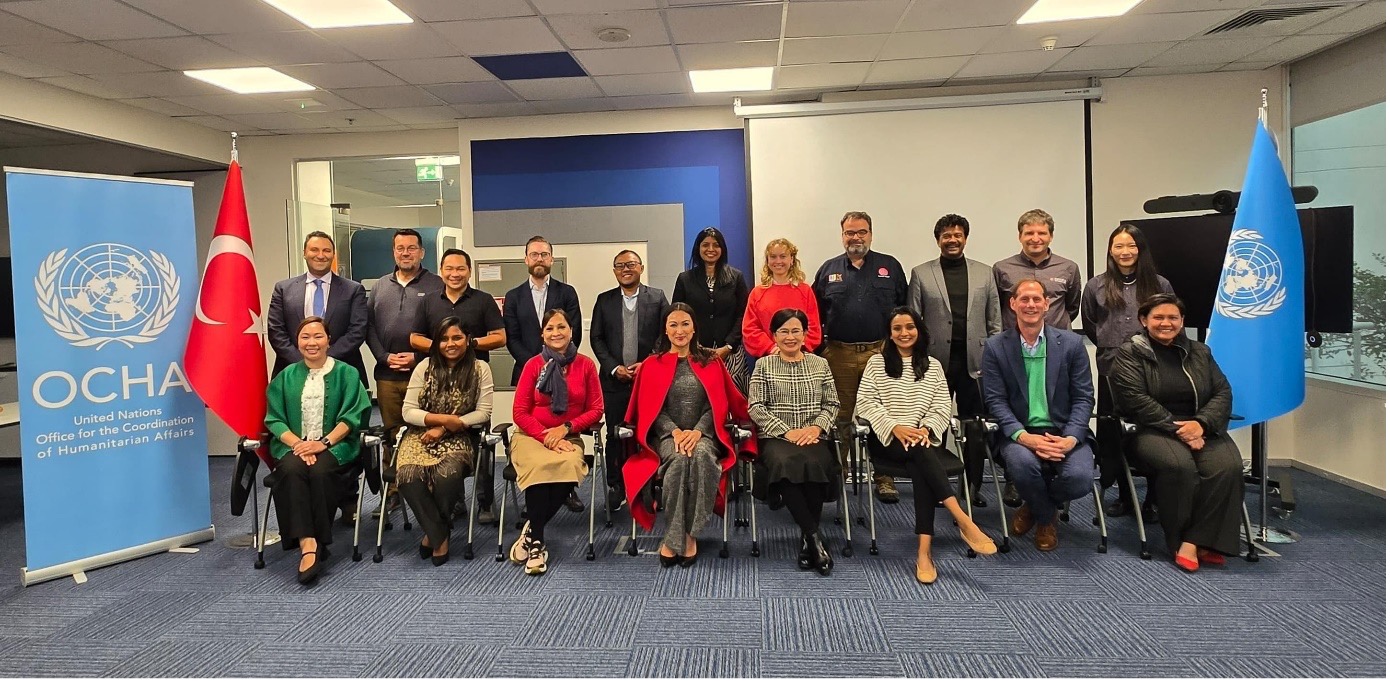The workshop participants and CBI team visited the OCHA Istanbul offices as part of the workshop programme. Photo: CBi.### What will the CBI Private Sector Coordination Playbook cover?
At the heart of our recent workshop was a shared ambition: to build a stronger, more coordinated private sector response to emergencies — one that is faster, smarter, and more inclusive.
We reflected on and tackled important questions:
- What should trigger the activation of a CBI Member Network in an emergency?
- What immediate steps should be taken to mobilize support?
- How can CBI and its broader "network of networks" step in when there is no Member Network present on the ground?
- And more importantly, how can business networks, already stretched thin responding to crises, integrate reporting in ways that are simple, meaningful, and sustainable?
Building on these discussions, CBI is now drafting a set of standard operating procedures or a Private Sector Coordination Playbook to share with our full community of Member Networks and partners. As the humanitarian system undergoes a major “reset” and funding becomes more constrained, collaboration, efficiency, and innovation are no longer optional — they are essential. Through this playbook, we aim to offer a practical and forward-looking framework that empowers the private sector to play an even more impactful role in humanitarian response.