# No one prepares alone: Businesses from the Philippines to Kenya get ready for a very strong El Niño
On the International Day for Disaster Risk Reduction, the Philippine Disaster Resilience Foundation (PDRF) and the OCHA-UNDP Connecting Business Initiative (CBI) brought together more than 300 business representatives to share tools for the 2026/27 El Niño and launch *Ready for Floods*, *a practical guide for businesses.*
El Niño is different from an earthquake in one important way: It comes with advance warning.
The 2026/27 event is already established and, according to the [World Meteorological Organization (WMO)](https://wmo.int/news/media-centre/el-nino-set-become-very-strong-raising-risks-of-extreme-weather-2027), is set to become one of the strongest on record, with impacts lasting well into 2027. For the Philippines and much of Southeast Asia that means heat, dry spells, and water shortages. For East Africa and the Pacific coast of South America it means heavier rain and flooding. In both cases, the window to prepare is now.
That was the starting point for a joint webinar on 13 October. Nearly 300 participants joined from a wide range of geographies and industries: energy and water utilities, manufacturing, food and beverage, banking, logistics, business process services and business associations, from small firms to multinationals. An opening poll set the tone: most participants felt only partly prepared.
## Decide before, not during
Veronica Gabaldon, PDRF's Executive Director, opened by making the case for why business belongs in the conversation: When the private sector is not part of preparedness, disruptions last longer, recovery is slower, and the impacts fall more heavily on people who are already vulnerable.
Laurent Giezendanner, Head of Corporate Security at Syngenta Group and Co-Chair of the United Nations Office for Disaster Risk Reduction (UNDRR) Corporate Chief Resilience Officers Network, turned that into a shareable methodology. His advice to companies of any size was to set trigger points in advance, observable facts such as dam levels or rainfall that tell you a scenario is developing, and to agree what each one triggers and who is accountable *before* the season starts.
"Decide before, and not during or after. Use peace time. Use the time that we have now in the context of El Niño."
He also pointed businesses to two free tools developed with UNDRR: [the Resilience Maturity Assessment, a 14-question benchmark of how ready a company is](https://www.undrr.org/media/96281/download?startDownload=20261026), and the [CCRO Network's new El Niño advisory](https://www.undrr.org/news/ccro-network-turns-roundtable-discussions-action-new-el-nino-advisory).
## **Seeing early, acting early**
Ralph Cedric Cabate, PDRF's Monitoring and Analysis Officer, walked through PDRF's new El Niño dashboard, a public platform that brings together the ENSO forecast, rainfall against normal, the drought outlook, and reservoir levels for the Philippines in one place. Each update comes with an advisory to member companies that sets thresholds for the water and power sectors, and PDRF is extending it to cover energy and agriculture impacts. The aim of the platform is to answer three critical questions: what is happening, what could be affected, and what should we do.
[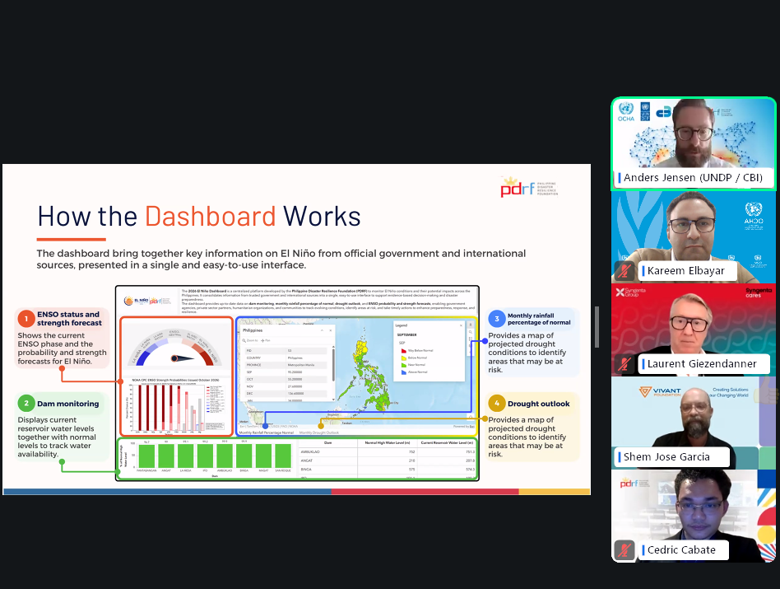](https://connectingbusiness.org/news/el-nino-preparedness-2026/)***PDRF's El Niño dashboard consolidates forecasts, rainfall, drought outlook and dam levels, with advisories to member companies.***Shem Jose Garcia, President of the Vivant Foundation, showed what that looks like from inside a company. Vivant, a Cebu-based enterprise in the power and water utilities industry, has reoriented its disaster response around what it does best. After an earthquake and a typhoon hit Cebu within a month last year, the company's new desalination plant, the first at utility scale in the Philippines, became a source of safe drinking water for affected communities, with PDRF member companies providing the trucks for its distribution. Its solar programme for schools now powers the buildings designated as evacuation centres.
"The best way businesses can contribute, is to do what they are expert at as a business."
## **Ready for Floods**
Because El Niño brings too much water to some regions even as it brings too little to others, CBI used the webinar to launch [Ready for Floods: A Practical Guide for Businesses.](https://connectingbusiness.org/knowledge-hub/publications/ready-for-floods-a-practical-guide-for-businesses/) Developed with input from CBI Member Networks and building on the flood experience of PDRF and A-PAD Sri Lanka, the guide is written for any business, from a market stall to a multinational.
[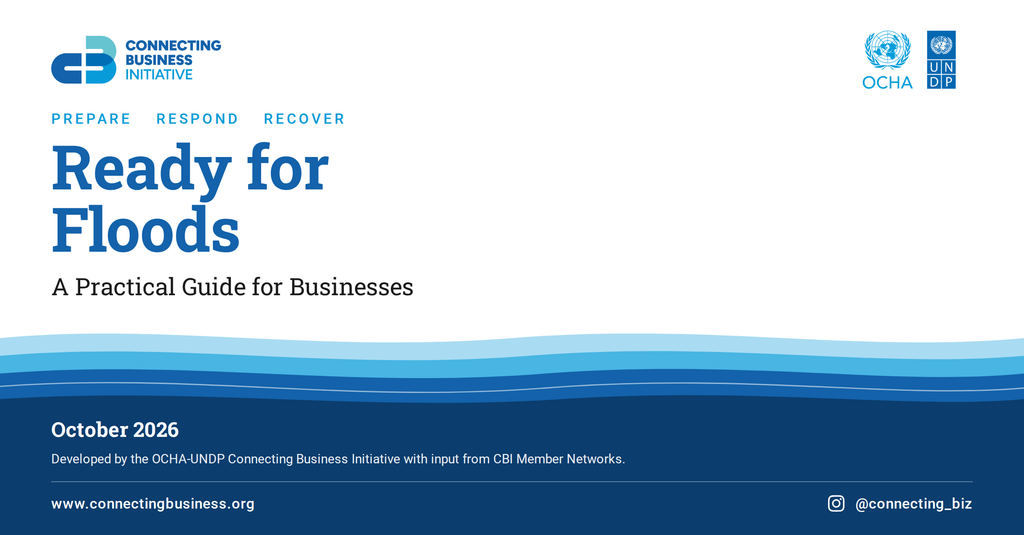](https://connectingbusiness.org/knowledge-hub/publications/ready-for-floods-a-practical-guide-for-businesses/)Kareem Elbayar, CBI Programme Coordinator and Head of OCHA’s Private Sector Unit, introduced it with a simple argument for acting early. Just 24 hours’ warning of a hazard can cut the resulting damage by up to 30 percent, and unlike an earthquake, floods usually come with days or even weeks of warning. Businesses that use that time, lose less and recover faster.
The guide is organized around five areas to act on, with checklists for each stage of a warning and a two-page flood plan at the back:
1. people,
2. premises and stock,
3. data,
4. customers and suppliers, and
5. keeping the business going.
## **No one holds all the cards**
The questions that came in, more than 40 before and during the session, were practical: how to account for staff when networks are down, what hydropower and geothermal operators should do, how food manufacturers should think about raw materials, and what the one non-negotiable is for any business. The answer to the last one came from every speaker in different words. Know what you depend on, and decide now what you will do when you lose it.
The webinar closed on the point it had started from. No single company, network or agency holds all the cards. Preparing for El Niño is something businesses do *together*.
Watch the recording [here](https://youtu.be/CFkRjJ5x78s). Read and share [Ready for Floods: A Practical Guide for Businesses](https://connectingbusiness.org/knowledge-hub/publications/ready-for-floods-a-practical-guide-for-businesses/). Explore [PDRF's El Niño dashboard](https://pdrf.maps.arcgis.com/apps/dashboards/5430aaf77d4b4bd5b7b35a88f9e84a69) and the [UNDRR Resilience Maturity Assessment](https://www.undrr.org/media/96281/download?startDownload=20261026). To connect with the CBI Member Network in your country, contact .